






Nonfiction
eBook
Details
PUBLISHED
DESCRIPTION
1 online resource
ISBN/ISSN
LANGUAGE
NOTES
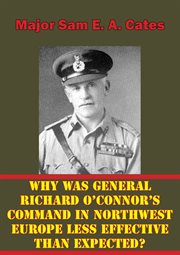
General Richard O'Connor was the British VIII Corps commander in Normandy 1944. Previously he forged an outstanding reputation as a large unit commander in the desert of North Africa and this form suggests his command in Northwest Europe would be faultless. However, this was not the case. Some historians explain his pedestrian performance in Normandy by pointing to his two and a half years as a prisoner of war in Italy. This monograph challenges this narrative suggesting instead that O'Connor's command style was not suited to the context of war in Normandy. General O'Connor had a wealth of relevant military experience. The crucible of World War and his experiences commanding the Western Desert Force in North Africa created in him a style of command that was best suited to independent operations, on ground that facilitated effective maneuver, and with conditions that enable the achievement of the element of surprise. Yet in Normandy 1944, the context in which General O'Connor commanded did not allow for any of these conditions. Rather, a constrictive chain of command, narrow fronts, restrictive terrain, and the difficulty of achieving surprise all combined to provide a context in which General O'Connor was a less effective corps commander than expected
Mode of access: World Wide Web