




Details
PUBLISHED
Made available through hoopla
DESCRIPTION
1 online resource
ISBN/ISSN
LANGUAGE
NOTES
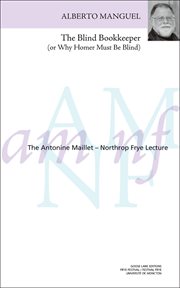
Rich with literary awards and honours, Alberto Manguel extends his literary genius to address and complete a thoughtfully crafted extrapolation on a paper left unfinished by Northrop Frye in 1943. The result is a succinct yet densely multilayered examination of how various readings of Homer throughout the annals of history cast light upon the human tendency towards war rather than peace and asks what roles writing and reading play to bring the world into better equilibrium. Central to this lecture is the concept of re-binding, a word drawn from the Latin roots for the word religion, which Manguel posits is the essential definition of poetry. Homer's writings, the point of origin of all written verse, are also the first written instance of the binding of imagined, written, and read realities. The semantics of Homer's name and the literal and figurative ramifications of his blindness are investigated as Manguel builds the scaffold for unveiling our own blindness through our desire to read Homer in our own image - much as humans have created gods in their own likenesses. We are left to examine our own assumptions and to ask whether we have the courage to challenge ourselves with alternative interpretations of constructed realities, in other languages, that may threaten our own comfortable construct of rightness and reality in order to explore and recognize the world in a more balanced way. Combľ de prix littřaires et d'honneurs, Alberto Manguel pr̊te son gňie littřaire ̉ l'ťude et au paracḧvement d'une extrapolation songě que Northrop Frye avait laissě en plan en 1943. Il en ršulte une analyse succincte mais en replis serrš des multiples lectures d'Hom̈re lǧuěs par les sïcles, qui řv̈le comment ces interprťations člairent la propension humaine ̉ la guerre plutt̥ qu'̉ la paix, ce qui le m̈ne ̉ s'interroger sur le r̥le que jouent l'čriture et la lecture quand il s'agit de crěr un monde plus ̌quilibř. La notion de re-lier, un mot dont les racines latines sont les m̊mes que le mot religion, est au coeur de cette confřence, et Manguel en fait la ďfinition essentielle de la pošie. Les črits d'Hom̈re, point d'origine de toute la pošie črite, fournissent aussi la premïre occurrence d'un lien entre les rǎlitš imaginěs, črites et lues. La valeur šmantique du nom d'Hom̈re et les řpercussions concrẗes et figurěs de sa cčiť font partie des ľ̌ments que Manguel scrute pour fonder son ̌vocation de notre aveuglement ̉ nous quand nous insistons pour lire Hom̈re ̉ notre propre image, comme le fait le genre humain pour les dieux et děsses qu'il crě. Nous n'avons plus qu'̉ remettre nos hypotḧses en cause et ̉ nous demander si nous avons le courage d'accepter le ďfi que posent des interprťations autres, dans d'autres langues, de la rǎliť construite, des interprťations qui pourraient ̌branler nos conceptions ± confortables ¬ du bien et de la rǎliť, afin de pouvoir explorer et reconna̋tre le monde de manïre plus ̌quilibrě
Mode of access: World Wide Web