






Nonfiction
eBook
Details
PUBLISHED
Made available through hoopla
DESCRIPTION
1 online resource
ISBN/ISSN
LANGUAGE
NOTES
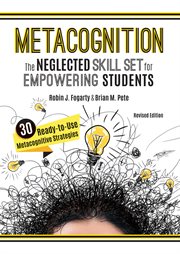
Empower your students to become mindful, reflective, and proficient thinkers and problem solvers. In Metacognition, authors Robin J. Fogarty and Brian M. Pete provide a practical framework to nurture these essential skills in every learner. Research-based and classroom-approved, this resource is a must-read for educators committed to strengthening student self-awareness, self-assessment, and self-confidence for school and life. Use this resource to implement the critical but overlooked practice of enhancing deep, reflective learning among students in the classroom: -Explore research that shows teaching metacognition--or reflective thinking--is one of the most high-impact strategies available to educators. -Acquire practices designed to empower learners to cultivate awareness and control over their own thinking. -Learn how to encourage students with positive feedback to go beyond the "right" answer by thinking deeply and critically. -Study the three categorical labels for the strategies that will help students develop metacognitive behaviors: (1) planning, (2) monitoring, and (3) evaluating. -Record and reflect on how you incorporate the teaching strategies into your classroom. Contents: Table of Contents Foreword Introduction Section I: Planning Strategies 1. Stem Statements [Thoughtful Lead-Ins] 2. Inking Your Thinking [Learning Logs] 3. Film Footage [Visualization] 4. Fat and Skinny Questions [Higher-Order Questions] 5. Roll the Dice [Predicting] 6. Pie in the Face [Making Inferences] 7. The Goal Post [Goal Setting] 8. A Road Map [Strategic Planning] 9. Seesaw Thinking [What-If Problem Solving] 10. Prime the Pump [KWL] Section II: Monitoring Strategies 1. Talk to Yourself [Think Aloud] 2. Soup Cans [Labeling Behaviors] 3. Alarm Clock [Recovery Strategies] 4. Instant Replay [Tape Recordings] 5. Sticky Note [Memoing] 6. Mental Menus [Tracking] 7. Cue Cards [Prompting] 8. Two-Way Talk [Conferencing] 9. Transfer Talk [Bridging] 10. The Microscope [Recorded Observations] Section III: Evaluating Strategies 1. Thumbs-Up/Thumbs-Down [PMI] 2. Choose Your Spot [The Human Graph] 3. Mrs. Potter's Questions [Evaluating] 4. A Revolving Door [The Portfolio Registry] 5. Connecting Elephants [How Can I Use This?] 6. The Big Idea [Generalizing] 7. Checkmate! [Self-Administered Checklists] 8. What? So What? Now What? [Student-Led Conferences] 9. Story Time! [Anecdotes] 10. Double-Talk [Double-Entry Journals] In Closing References and Resources Index
Mode of access: World Wide Web