






Fiction
eBook
Details
PUBLISHED
Made available through hoopla
DESCRIPTION
1 online resource
ISBN/ISSN
LANGUAGE
NOTES
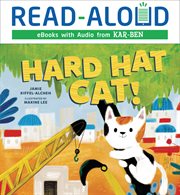
Kar-Ben Read-Aloud eBooks with Audio combine professional narration and text highlighting to bring eBooks to life! Of all the stray cats in Israel, a kitten sits high in a tree above girders, beams, cement mixers and cranes. Avi wants to adopt the friendly kitten although his mom-and the family dog- don't like the idea. But every day the clever cat comes back, becoming a family's "forever cat"! "Hard Hat Cat! written by Jamie Kiffel-Alcheh and delightfully illustrated by Maxine Lee, follows a young boy and a special little cat. The boy lives across the street from a construction site. He is befriended by a kitten who lives near the site. But, as his mom tells im, Israel is filled with stray cats and they can't take care of them all. Not to mention, they already own…a Woof! But Kitten returns day after day and finally the boy tries his best to find his friend a good home. Then one day, Kitten disappears, and the search is on. A happy surprise ends this fun story of caring and friendship." - Marcia Berneger, San Diego Jewish World "Many Jewish children in the United States have an image of Israel, which comes from news headlines, Hebrew school classes, or tourists' accounts. These impressions are often skewed; they present only a small slice of the complex life in the vibrant, modern Israeli culture where children, similar to the reader, live daily lives that are different than and yet parallel to their own. It is always refreshing to find a story written for American children which reflects everyday Israel in a way that is both characteristic, yet familiar. This simple picture book about a young Israeli boy who feeds a stray kitten near a construction site addresses a universal theme but has an authentic Israeli flavor. Young Ari feeds the abandoned kitten and worries about its future, hoping to find a family who will adopt the little cat and will care for it with love. The story uses Hebrew terms in a natural and unforced way, blending the Hebrew vocabulary seamlessly into the tale. While roaming the streets, the kitten passes a felafel stand, the local borekas man, and the shuk. Israel is known for its stray cat population and Ari's safta (grandmother) and doda (aunt) tell him about the many street cats prowling the cities. Ari is overjoyed when he finds a family who wants to adopt the kitten and care for it, blending the story's theme of Israeli life with the important Jewish value of kindness to all living beings. The bold, bright illustrations are an integral part of this colorful picture of Israeli life. Round-faced, smiling, lively people reflect the diversity of Israel's population, red-roofed houses evoke Israeli cities and towns, and the appealing kitten will make young readers wish for pets of their own. An author's note tells readers that the story is based on her own personal encounter with a stray kitten in Israel and a glossary of the Hebrew terms used in the story is included." - Michel Hoschander Malen, Jewish Book Council "This picture book tells the story of how a stray cat, who hangs out at a construction site in Israel, comes to find his forever home. The story is told from the perspective of Ari, a young boy who notices the cat but whose mom won't let him keep it. Children will be able to relate to Ari's desire to keep the stray animal and they will follow along as Ari visits all of his neighbors, trying to entice them to adopt the cat. Kiffel-Alcheh's writing is an unusual blend of poetry, prose, and sounds. While the plot will appeal to children as old as 8, the writing contains onomatopoeic words geared towards a much younger audience ("meow meow, bzz bzz!, bang bang," etc.). Some older children might be put off by that. Still, the pacing of the story is e
Mode of access: World Wide Web