




Nonfiction
eBook
Details
PUBLISHED
Made available through hoopla
DESCRIPTION
1 online resource
ISBN/ISSN
LANGUAGE
NOTES
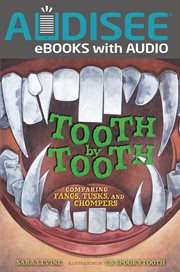
Audisee® eBooks with Audio combine professional narration and sentence highlighting for an engaging read aloud experience! Open wide! Compare your teeth to those of other animals and find out why teeth come in so many different shapes and sizes. What animal would you be if a few of your teeth grew so long that they stuck out of your mouth even when it was closed? What would you be if your top canine teeth grew almost all the way down to your feet? This picture book will keep you guessing as you read about how human teeth are like-and unlike-those of other animals. Praise for Bone by Bone: Comparing Animal Skeletons "Children will enjoy the humorous illustrations and labeled diagrams as they predict the morphing of a human skeleton, Dr. Moreau-style, into that of various animals."-Booklist "[Levine's] 'what if' questions are right on target for young learners, connecting them to the subject and extending their imaginations."-Kirkus Reviews "[I]nteractive and thought-provoking."-School Library Journal "A guessing game meets zoological dentistry in this informational picture book. Facts are on every page, starting at the beginning, with an introduction to types of human teeth. From there, the narrator invites readers to guess what type of mammal they'd be if, for example, 'your top canine teeth grew almost all the way down to your feet.' A page turn reveals the answer: 'A walrus!' The mammals range from the easily guessed, like an elephant, to the more obscure, such as the pangolin, which has no teeth at all. With playful text and a kid-friendly approach, this title's cleverest part is the reinforcement of toothcabulary: kids will walk away with a comprehensive understanding of the difference between incisors, canines, and molars. Spookytooth's full-color, collage-like illustrations show off a diverse group of kids with round, expressive faces and, of course, wide toothy smiles that, though maybe a bit unsettling when packed with animal chompers, will surely elicit some giggles. A great addition to any library where animal books are popular-so, almost all of them."-Booklist "An engaging text invites readers to open wide and look in the mirror to see their three types of teeth (and maybe a bit of food, as in some of the illustrations). Big-headed cartoon kids are depicted with animal teeth in their giant, teeth-filled mouths, and the author asks questions such as 'What kind of mammal would you be if your top and bottom canine teeth curled up out of your mouth so you had two pairs of tusks?' The following page provides answers. Readers also find out that horses, cows, and giraffes have really tall molars, as do sheep, goats, llamas, antelopes, deer, and zebras. Readers won't want to stop until they reach the last tooth. A brief overview of fish, amphibian, and reptile teeth complements the information on mammal teeth. VERDICT: Playful and laugh-out-loud funny, this informative picture book belongs in every dentist office and library."-School Library Journal "Adopting an interactive, question-and-answer approach, Levine introduces children to common characteristics and variations in the teeth of mammals. Directly addressing readers, the author invites them to identify the three types of mammal teeth (incisors, canines, and molars) by looking into a mirror. 'Do you see the flat teeth in front? Those are your incisors. If you haven't lost any recently, you should have four on top and four on the bottom. How many do you have?' Next, Levine asks readers to guess which kind of mammal they'd be if they sported particular types of teeth-for example, 'if you had really long canines?' A page turn delivers an answer, capitalized exuberantly: 'A SEAL OR A CAT OR A DOG OR A BEAR!' (Asterisked footnotes often add additional examples.) Spookytooth's flat, stylized, presumably digitally composed pictures incorporate textures of watercolor and wood, using shadows to suggest depth and dimension
Mode of access: World Wide Web