






Details
PUBLISHED
Made available through hoopla
DESCRIPTION
1 online resource
ISBN/ISSN
LANGUAGE
NOTES
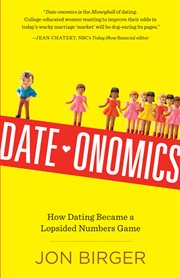
It's not that he's just not that into you-it's that there aren't enough of him. And the numbers prove it. Using a combination of demographics, statistics, game theory, and number-crunching, Date-onomics tells what every single, college-educated, heterosexual, looking-for-a-partner woman needs to know: The "man deficit" is real. It's a fascinating, if sobering read, with two critical takeaways: One, it's not you. Two, knowledge is power, so here's what to do about it. The shortage of college-educated men is not just a big-city phenomenon frustrating women in New York and L.A. Among young college grads, there are four eligible women for every three men nationwide. This unequal ratio explains not only why it's so hard to find a date, but a host of social issues, from the college hookup culture to the reason Salt Lake City is becoming the breast implant capital of America. Then there's the math that says that a woman's good looks can keep men from approaching her-particularly if they feel the odds aren't in their favor. Fortunately, there are also solutions: what college to attend (any with strong sciences or math), where to hang out (in New York, try a fireman's bar), where to live (Colorado, Seattle, "Man" Jose), and why never to shy away from giving an ultimatum. Jon Birger is a contributor to Fortune magazine. A former senior writer at Fortune and Money, he's an award-winning freelance journalist who has written for Time, Barron's, and Bloomberg BusinessWeek. He has appeared on MSNBC, CNN, CNBC, National Public Radio, and Fox News, sharing his expertise on topics ranging from the stock market to oil prices. A graduate of Brown University, Mr. Birger lives with his family in Larchmont, New York. Chapter One The Man Deficit My friend Sarah Donovan* is a gem. She's kind. She's funny. She's an Ivy Leaguer, and a head-turner too. Professionally, Sarah is a star: a top journalist as well as a familiar face and voice on television and radio. Sarah is also 41 years old and unmarried. And it is this predicament-one that saddens Sarah, perplexes her friends, and frustrates her parents-that is the catalyst for this book. American cities are filled with Sarah Donovans-educated, successful, personable, often attractive women whose dating woes make little sense to those around them. "Come to think of it, I don't think I've ever had someone ask me if they knew any nice girls for their son," said Jeffrey Sirkman, the longtime rabbi at Larchmont Temple in Larchmont, New York, and a keen observer of the marriage market. "But just about every week some mother or father will ask me whether I know of any nice guys for their daughter. Why is that?" Why indeed. Why is it that women like Donovan struggle to find marriage-material men even as male counterparts with less going for them seem to have little trouble with the opposite sex? Attempts to answer such questions have spawned a cottage industry of self-help books for women-dating guides that portray the failure to find Mr. Right as a strategic problem, one that can be fixed by playing hard to get or by following a few simple dating "rules." Underlying all such advice is an assumption that the perceived shortage of college-educated men-a phenomenon that I call "the man deficit"-is actually a mirage. At birth there are more boys than girls: 1.05 boys are born in the U.S. for every 1 girl. So if college educated women just become better daters-if they can get inside men's heads and understand what makes them commit-there should be enough college-educated men out there for everyone. But what if the problem is not strategic? What if most of the good men are taken? What if a disproportionate number of the single guys still out there really are incorrigible commitment-phobes just looking for a good time? Wha
Mode of access: World Wide Web