



Nonfiction
eBook
Details
PUBLISHED
Made available through hoopla
DESCRIPTION
1 online resource
ISBN/ISSN
LANGUAGE
NOTES
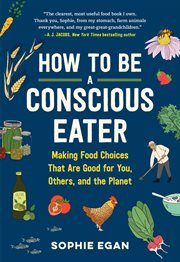
A radically practical guide to making food choices that are good for you, others, and the planet. Is organic really worth it? Are eggs ok to eat? If so, which ones are best for you, and for the chicken-Cage-Free, Free-Range, Pasture-Raised? What about farmed salmon, soy milk, sugar, gluten, fermented foods, coconut oil, almonds? Thumbs-up, thumbs-down, or somewhere in between? Using three criteria-Is it good for me? Is it good for others? Is it good for the planet?-Sophie Egan helps us navigate the bewildering world of food so that we can all become conscious eaters. To eat consciously is not about diets, fads, or hard-and-fast rules. It's about having straightforward, accurate information to make smart, thoughtful choices amid the chaos of conflicting news and marketing hype. An expert on food's impact on human and environmental health, Egan organizes the book into four categories-stuff that comes from the ground, stuff that comes from animals, stuff that comes from factories, and stuff that's made in restaurant kitchens. This practical guide offers bottom-line answers to your most top-of-mind questions about what to eat. "The clearest, most useful food book I own."-A. J. Jacobs, New York Times bestselling author A lively, surprising, and necessary guide to navigating our food choices-is a certain food OK for your health? OK for the environment? How do I know if the people who grow or create it are fairly treated?-by an expert in public health from the Culinary Institute of America. Sophie Egan, MPH is director of health and sustainability leadership as well as the editorial director for strategic initiatives at The Culinary Institute of America. Based in San Francisco, Egan is a contributor to The New York Times' health section, and she has written about food and health for The Washington Post, EatingWell, Time, The Wall Street Journal, Bon Appétit, WIRED, Edible San Francisco, and other publications. Her first book, Devoured: How What We Eat Defines Who We Are (William Morrow/HarperCollins, 2016), is a journey into the American food psyche. Egan holds a master of public health, with a focus on health and social behavior, from the University of California, Berkeley, where she was a Center for Health Leadership fellow. She also holds a bachelor of arts with honors in history from Stanford University. In 2016, she was named one of the UC Global Food Initiative's 30 Under 30. In 2018, she earned a certificate from the Harvard Executive Education in Sustainability Leadership program at the Center for Climate, Health, and the Global Environment. Introduction 1. Stuff that comes from the ground - Sugars: In defense of fruit - Almonds: health nuts or water hogs? - Arsenic and old rice - Looking for a humble hero? Beans - The best produce is the kind you eat - You Should Buy Organic, when you can afford it - Radically practical tips for buying produce - Why water beats all, and tap beats bottle - Top 5 ways to waste less food at home - The glory of whole grains and why you shouldn't miss out - Grains that are good for your fellow humans and the planet - Fat in food: the essentials - From soy to nuts, what to know about plant-based "milks" - Fermented foods and fiber: bring on the bacteria - Pollinator protection: what's at stake and how you can help - A gentle rain on the plant-based parade - How to choose a cooking oil - The olive oil vs. coconut oil showdown - Frozen foods: it's the freezers we need to deal with - SOS: save our souls soils - Label Lounge: stickers to know for stuff that comes from the ground2. Stuff that comes from animals - The Great Protein Myth - The conscious carnivore: First, less. Then, better - Why fish and seafood are worth your while - Sustainability at sea: a primer
Mode of access: World Wide Web