




Nonfiction
eBook
Details
PUBLISHED
Made available through hoopla
DESCRIPTION
1 online resource
ISBN/ISSN
LANGUAGE
NOTES
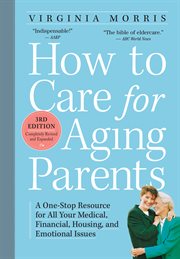
The book that answers all the questions you hoped you'd never have to ask. Hailed as "an excellent resource" by the Family Caregiver Alliance, How to Care for Aging Parents is an indispensable source of information and support. Now completely revised and updated, this compassionate, comprehensive caregiver's bible tackles all the touch subjects, from how to avoid becoming your parent's "parent," to understanding what happens to the body in old age, to getting help finding, and paying for, a nursing home. When love is not enough-and regrettably, it never is-this is the essential guide. Help for every difficult issue: - Knowing when to intervene - Coping with dementia - Caring for the caregiver - The question of driving - Paying for long-term care - Sharing the care with siblings - Caregiving from a distance - Home care vs. a nursing home - The hospice option An award-winning journalist, Virginia Morris has devoted her career to researching and writing about health care, medical research and related social and political issues for the last 30 years. She is the author of How to Care for Aging Parents, which won the Books for a Better Life Award and instantly became the best-selling book on the subject when it was first released in 1996. It has sold more than 500,000 copies and has been translated into a number of languages. AARP calls it "indispensable." ABC World News declared it the "the bible for caregivers." And the Wall Street Journal touted it as "the best guide." The third edition was published in 2014. She is also the author of Talking About Death, which came out in 2001. Virginia has been featured on Oprah, The Today Show, Good Morning America, The CBS Morning Show, Primetime, ABC World News with Diane Sawyer, NPR, CNN, and a host of other national media. She testified before Congress at the invitation of Sen. Amy Klobuchar. She now serves as adjunct instructor at Dartmouth's Geisel School of Medicine, is a member of the Dartmouth-Hitchcock ethics committee, is getting a master's degree in bioethics at Harvard, and gives talks around the country on aging, caregiving and end-of-life decisions. On Care-giving: "If there was such a thing as Care-givers Anonymous, the first step in the program would be to get rid of that little voice inside you that says, I can do it all, I am responsible for everything, and whatever I do, it's never enough. Of course you want to make your parent well, make her happy, make her safe. In fact, if it were possible for you to be with her every minute of the day, perhaps you would be, But the truth is that you can't personally do everything that needs to be done for her, and trying to do so will only exhaust and frustrate you without really helping your parent over the long haul. So how do you use your energies most effectively? IF your mother has a sudden and severe illness, of course you'll want to be there. But when her needs are more chronic, when you find yourself taking on more and more responsibility over a matter of months or years, you must step back, take a realistic look at the situation and draw some boundaries for yourself. Determine what you can reasonably do for your parent and, more important, what you have to stop trying to do. As hard as this is, you may be surprised to discover that setting some limits will relieve your guilt and ease some tension. And you will have more patience and energy for those things that only you can give. "For a long time I visited my mother twice a week, but I was always running and always tired. I started to dread each visit and I was angry at her because I felt it was all her fault. She was ruining my life. Then a friend said to me, 'This isn't her fault. It's your fault.' And, you know, she was right." - Fran M. On Medicaid and Nursing homes: There
Mode of access: World Wide Web