






Nonfiction
eBook
Details
PUBLISHED
Made available through hoopla
DESCRIPTION
1 online resource
ISBN/ISSN
LANGUAGE
NOTES
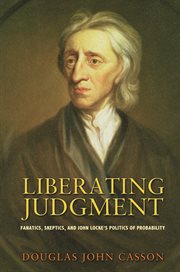
Examining the social and political upheavals that characterized the collapse of public judgment in early modern Europe, Liberating Judgment offers a unique account of the achievement of liberal democracy and self-government. The book argues that the work of John Locke instills a civic judgment that avoids the excesses of corrosive skepticism and dogmatic fanaticism, which lead to either political acquiescence or irresolvable conflict. Locke changes the way political power is assessed by replacing deteriorating vocabularies of legitimacy with a new language of justification informed by a conception of probability. For Locke, the coherence and viability of liberal self-government rests not on unassailable principles or institutions, but on the capacity of citizens to embrace probable judgment. The book explores the breakdown of the medieval understanding of knowledge and opinion, and considers how Montaigne's skepticism and Descartes' rationalism--interconnected responses to the crisis--involved a pragmatic submission to absolute rule. Locke endorses this response early on, but moves away from it when he encounters a notion of reasonableness based on probable judgment. In his mature writings, Locke instructs his readers to govern their faculties and intellectual yearnings in accordance with this new standard as well as a vocabulary of justification that might cultivate a self-government of free and equal individuals. The success of Locke's arguments depends upon citizens' willingness to take up the labor of judgment in situations where absolute certainty cannot be achieved
Mode of access: World Wide Web