





Details
PUBLISHED
Made available through hoopla
DESCRIPTION
1 online resource
ISBN/ISSN
LANGUAGE
NOTES
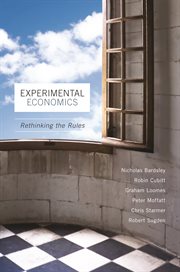
Nicholas Bardsley is senior research fellow at the National Centre for Research Methods, University of Southampton. Robin Cubitt is professor of economics and decision research at the University of Nottingham. Graham Loomes is professor of economic behavior and decision theory at the University of East Anglia. Peter Moffatt is reader in econometrics at the University of East Anglia. Chris Starmer is professor of experimental economics at the University of Nottingham. Robert Sugden is professor of economics at the University of East Anglia. Since the 1980s, there has been explosive growth in the use of experimental methods in economics, leading to exciting developments in economic theory and policy. Despite this, the status of experimental economics remains controversial. In Experimental Economics, the authors draw on their experience and expertise in experimental economics, economic theory, the methodology of economics, philosophy of science, and the econometrics of experimental data to offer a balanced and integrated look at the nature and reliability of claims based on experimental research. The authors explore the history of experiments in economics, provide examples of different types of experiments, and show that the growing use of experimental methods is transforming economics into a genuinely empirical science. They explain that progress is being held back by an uncritical acceptance of folk wisdom regarding how experiments should be conducted, a failure to acknowledge that different objectives call for different approaches to experimental design, and a misplaced assumption that principles of good practice in theoretical modeling can be transferred directly to experimental design. Experimental Economics debates how such limitations might be overcome, and will interest practicing experimental economists, nonexperimental economists wanting to interpret experimental research, and philosophers of science concerned with the status of knowledge claims in economics. "Experimental Economics is a well intentioned book which does an admirable job in consolidating and modernising the ongoing methodological debates surrounding experimental economics. . . . I would recommend this book to empirical social scientists, particularly the first two parts, which crystallise the major debates ongoing in the discipline."---Tom Wilkening, The Economic Record "This is an extremely rich and cultured book that makes a large number of intelligent points about experimental methods. It also raises sophisticated questions concerning what it means to test a theory and how one can test in an environment in which an error model unconstrained by theory is essential to judging empirical fit."---Andrew Caplin, Journal of Economics and Philosophy "The authors of this book have pulled off a remarkable feat: a page-turner on experimental economics that will appeal to a wide audience. Noneconomists and nonexperimentalists will be treated to a fascinating introduction to the methods, philosophy, and controversy of this rapidly expanding area of research. Experimental economists will get a whole new perspective on their field that will make them think differently about their own work. Not to be missed!"-George Loewenstein, Carnegie Mellon University "Experimental Economics fills an important gap in the literature. It provides a thoughtful and rigorous treatment of key methodological and conceptual issues that are frequently discussed informally by experimental economists but are rarely addressed explicitly. I would recommend it for students and current practitioners of experiments, as well as experienced economists who would like to learn more about how experiments are useful in advancing economic science."-Timothy Cason, Purdue University "Economists increasingly run experiments. How do they justify and motivate their work? Are their methods sound? Read this book and you will be wiser."-Martin Dufwenberg, University of Arizona "This interesting
Mode of access: World Wide Web