






Nonfiction
eBook
Details
PUBLISHED
Made available through hoopla
DESCRIPTION
1 online resource
ISBN/ISSN
LANGUAGE
NOTES
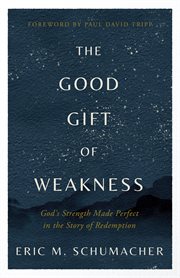
This overview of the theme of weakness in the Bible offers readers practical encouragement and hope as they learn to view their frailties as part of God's plan and purpose for their lives. Our culture deifies strength-and sadly, the church does too. Who has the most successful ministry, the largest congregation, or the godliest family? Our misplaced faith in human strength is a false hope with no basis in Scripture. But a closer look throughout the Bible reveals the central role human frailty plays in the redemption story. From Genesis to Revelation, God's power is made perfect when people are at their weakest. Far from an undesirable defect, God designed our weakness to draw us closer to himself. As you learn to accept the good gift of weakness, you will experience true strength-the kind that only comes from a loving and infinitely powerful God. This overview of the theme of weakness in the Bible offers readers practical encouragement and hope as they learn to view their frailties as part of God's plan and purpose for their lives. "In reading biblical theologies, I regularly have "aha!" moments as bits of Bible come together into a coherent whole. That happened for me again and again as I read The Good Gift of Weakness. This book helped me to see the good purpose God has had since the very beginning in making us creatures of weakness and dependence. In fact, weakness will not be eradicated in the New Creation! We will always need what only God provides. This book will fill you with wonder that Jesus became weak, and it will encourage you in the weak places of your life as you see that Jesus doesn't despise weakness. Indeed, he is drawn to it." -Nancy Guthrie, author and Bible teacher "Eric Schumacher takes us on a tour of the entire Bible as he explores the theme of weakness. We see that weakness is a pervasive theme in Scripture, imprinting on us that without Christ we can do nothing. We need the sovereign work of God the Father through the atoning work of Christ the Son and the applicatory work of the Holy Spirit every day. Schumacher communicates this truth both biblically and personally. I am grateful for the biblical faithfulness and the honest vulnerability that characterize this wonderful book. When we are weak, then we are strong in the Lord." -Thomas R. Schreiner, author, associate dean at The Southern Baptist Theological Seminary "Nothing feels more shameful in our culture than weakness, so we hide it and pretend we are strong. Eric Schumacher, with the insight of a trusted scholar and the grace of a trusted friend, deconstructs that self-defeating shame. This book points us to the Christ whose glory shines through our vulnerability." -Russell Moore, editor in chief of Christianity Today "Weak is not a word I like to use to describe myself. I want to be seen as strong, invincible, steadfast. Yet every day I encounter my weakness and frailty-body, mind, spirit, and soul. In The Good Gift of Weakness, Eric Schumacher poignantly lays out a biblical theology of weakness, highlighting the hope and help we have in Jesus. Compelling, convicting, and comforting, this book will guide your weak and weary soul toward the true, persevering strength found only in Jesus Christ." -Gretchen Saffles, bestselling author of The Well-Watered Woman "Eric shares vulnerably and wisely about his own experiences with weakness in a way that gives us a new framework that makes weakness feel like a strength. With refreshing honesty and a good dose of humor, Eric's words both remind us we're not alone and stir our affection for God and his design." -Laura Wifler, author, podcaster, and cofounder of Risen Motherhood "I would expect any book written by my friend Eric to be filled with deep wisdom and biblical clarity. What I didn't expect was the depth o
Mode of access: World Wide Web