





Nonfiction
eAudiobook
Details
PUBLISHED
Made available through hoopla
EDITION
DESCRIPTION
1 online resource (1 audio file (9hr., 32 min.)) : digital
ISBN/ISSN
LANGUAGE
NOTES
Read by Sean Patrick Hopkins
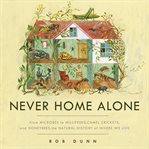
A natural history of the wilderness in our homes, from the microbes in our showers to the crickets in our basements Even when the floors are sparkling clean and the house seems silent, our domestic domain is wild beyond imagination. In Never Home Alone, biologist Rob Dunn introduces us to the nearly 200,000 species living with us in our own homes, from the Egyptian meal moths in our cupboards and camel crickets in our basements to the lactobacillus lounging on our kitchen counters. You are not alone. Yet, as we obsess over sterilizing our homes and separating our spaces from nature, we are unwittingly cultivating an entirely new playground for evolution. These changes are reshaping the organisms that live with us -- prompting some to become more dangerous, while undermining those species that benefit our bodies or help us keep more threatening organisms at bay. No one who reads this engrossing, revelatory book will look at their homes in the same way again. Rob Dunn is a professor in the Department of Applied Ecology at North Carolina State University and in the Natural History Museum of Denmark at the University of Copenhagen. He is the author of The Man Who Touched His Own Heart, The Wild Life of Our Bodies, and Every Living Thing, and his magazine work is published widely, including in National Geographic, Natural History, New Scientist, Scientific American, and Smithsonian. He has a PhD from the University of Connecticut and was a Fulbright Fellow. He lives in Raleigh, North Carolina. "Utterly a spirited romp through the vast diversity that inhabits our daily lives and how we've changed our ecosystems, often for the worse."-Washington Post "In his fascinating new Dunn brings a scientist's sensibility to our domestic jungle by exploring the paradox of the modern Mr. Dunn also gracefully explains, without getting bogged down in details, the technology that has allowed scientists during the past decade or so to sequence the DNA of millions of previously unknown microbes, making his book an excellent layperson's guide to cutting-edge research."-Wall Street Journal "Chatty, it's hard not to be occasionally charmed by [Dunn's] prose, as when he catalogs the arthropods with whom we share our And it's hard not to share, at least a little, his awe at their diversity, even in a single household."-New York Times Book Review "[A] fascinating and illuminating Dunn and his colleagues have used the concepts and techniques of community ecology to tease apart the functioning of a mostly ignored ecosystem: the human home. Their research enriches our understanding of ecosystem function, and--more grippingly--gives us insight into how our interactions with living things in the domestic habitat affect our health and well-being."-Nature "Never Home Alone is a thumping good book that raises alarm and offers reassurance in roughly equal measure. And it is What makes [it] so compelling is a sense of wonder and delight that encompasses all sorts of creatures and all sorts of science."-Los Angeles Review of Books "I Seen through Dunn's curious eyes, a house becomes not just a set of rooms, but a series of habitats to be explored. His writing and research lend a new appreciation of what many of us consider pests."-Science News "If you're an insectophobe looking for a thrill, you'll love Rob Dunn's Never Home Alone, which details the thousands of species of insects and microbes that live in and around your home."-Bustle "If you could somehow infuse the curiosity of a 6-year-old with Ph.D.-level intelligence, imagine what wondrous things you could learn. Or why not make it easier on yourself, and just read Never Home Alone. Yes, that delightful, open-minded gee-whiz is exactly what makes this book so enjoyable. Surprisingly, it's doubly so for a germophobe, an arachnophobe, or anyone who can't stand the idea of intruders. Dunn has a way of bru
Mode of access: World Wide Web