






Details
PUBLISHED
Made available through hoopla
DESCRIPTION
1 online resource (122 pages)
ISBN/ISSN
LANGUAGE
NOTES
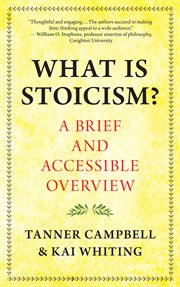
An easy, jargon-free introduction to Stoicism that covers the full range of Stoic thought in a single compact volume The word stoic has undergone an odd transformation over time. Today, we use it to mean someone who is indifferent to pleasure or pain. In ancient times, however, a Stoic was a member of a philosophical school whose original members gathered in Athens at a painted colonnade - or stoa in Greek. The modern meaning of the word gives some people the impression that Stoicism is cold and inhumane. In reality, Stoicism is a humanistic philosophy designed to help its practitioners find an inner peace that cannot be shaken by outer events. Some modern thinkers have noticed parallels between Stoic principles and the techniques of modern cognitive behavioral therapy. In What Is Stoicism?, Tanner Campbell and Kai Whiting introduce Stoicism to a new generation. Divided into short chapters that can be read in brief sittings, the book compresses several hundred years of Stoic thought into simple conversational prose. With present-day examples and quotes from famous Stoics, this whistle-stop tour of Stoicism covers topics such as: - the three pillars of Stoic philosophy: logic, physics, and ethics - the ultimate goal of Stoicism: sagehood - the Stoic concept of circles of concern: our individual obligations to our family, community, and world - the Stoic ideal of living in accordance with nature - the question of whether belief in God is necessary for practicing Stoicism During the journey, readers will meet some of the larger-than-life characters who have embodied Stoic ideals: Epictetus, a disabled former slave who became a respected teacher of Stoicism; the Roman statesman Seneca the Younger, the mentor of the infamous Roman emperor Nero; and the philosopher emperor Marcus Aurelius, whose austere Meditations have inspired thinkers for nearly two millennia. In the end, readers will come to appreciate the vitality of Stoicism and realize how the wisdom of the past can meet the challenges of the future
Mode of access: World Wide Web