






Details
PUBLISHED
Made available through hoopla
DESCRIPTION
1 online resource (432 pages)
ISBN/ISSN
LANGUAGE
NOTES
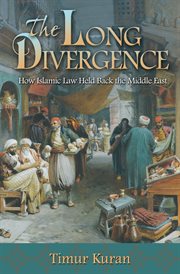
Timur Kuran is professor of economics and political science and the Gorter Family Professor of Islamic Studies at Duke University. He is the author of Islam and Mammon: The Economic Predicaments of Islamism (Princeton). How religious barriers stalled capitalism in the Middle East In the year 1000, the economy of the Middle East was at least as advanced as that of Europe. But by 1800, the region had fallen dramatically behind-in living standards, technology, and economic institutions. In short, the Middle East had failed to modernize economically as the West surged ahead. What caused this long divergence? And why does the Middle East remain drastically underdeveloped compared to the West? In The Long Divergence, one of the world's leading experts on Islamic economic institutions and the economy of the Middle East provides a new answer to these long-debated questions. Timur Kuran argues that what slowed the economic development of the Middle East was not colonialism or geography, still less Muslim attitudes or some incompatibility between Islam and capitalism. Rather, starting around the tenth century, Islamic legal institutions, which had benefitted the Middle Eastern economy in the early centuries of Islam, began to act as a drag on development by slowing or blocking the emergence of central features of modern economic life-including private capital accumulation, corporations, large-scale production, and impersonal exchange. By the nineteenth century, modern economic institutions began to be transplanted to the Middle East, but its economy has not caught up. And there is no quick fix today. Low trust, rampant corruption, and weak civil societies-all characteristic of the region's economies today and all legacies of its economic history-will take generations to overcome. The Long Divergence opens up a frank and honest debate on a crucial issue that even some of the most ardent secularists in the Muslim world have hesitated to discuss. "Kuran's book offers the best explanation yet for why the Middle East has lagged. After poring over ancient business records, Professor Kuran persuasively argues that what held the Middle East back wasn't Islam as such, or colonialism, but rather various secondary Islamic legal practices that are no longer relevant today."---Nicholas D. Kristof, New York Times "This is a book to be not just tasted but chewed and digested. Instead of facile claims that Islam is the solution or Islam is the problem, readers get a detailed history of economic institutions in the Middle East as compared to those in the West. Kuran shows that the Islamic law and practices underlying Middle Eastern commerce worked well for a long time and were much more flexible than usually assumed. . . . Clearly presented quantitative data and illuminating anecdotes add up to a fine feast."---L. Carl Brown, Foreign Affairs "Kuran's arguments have broad implications for the debate about how to foster economic development. He demonstrates that the West's long ascendancy was rooted in its ability to develop institutions that combined labour and capital in imaginative new ways." "Kuran's thesis is contentious; but it does provide us with an incentive to reformulate Islamic law. It is an excellent starting-point for a debate long overdue."---Ziauddin Sardar, The Independent "The Long Divergence offers a pathbreaking analysis of why the flourishing premodern economies of the Islamic world fell into relative decline as Western Europe rose. And it explores the issue of whether conservative Islam is compatible with modern economic institutions. You'll be surprised by many of his conclusions."---Peter Passell, Milken Institute Review "A ground-breaking book. . . . Kuran argues Islamic law primarily failed to develop the concept of a corporation: an economic and legal construct, separated from family and tribal loyalty, designed to encourage investment and profit sharing."---Chris Berg, Sydney Morning Herald "In an interesting n
Mode of access: World Wide Web