






Nonfiction
eBook
Details
PUBLISHED
Made available through hoopla
DESCRIPTION
1 online resource
ISBN/ISSN
LANGUAGE
NOTES
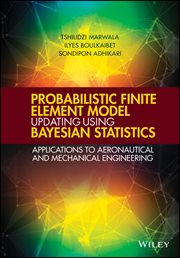
Probabilistic Finite Element Model Updating Using Bayesian Statistics: Applications to Aeronautical and Mechanical Engineering Tshilidzi Marwala and Ilyes Boulkaibet, University of Johannesburg, South Africa Sondipon Adhikari, Swansea University, UK Covers the probabilistic finite element model based on Bayesian statistics with applications to aeronautical and mechanical engineering Finite element models are used widely to model the dynamic behaviour of many systems including in electrical, aerospace and mechanical engineering. The book covers probabilistic finite element model updating, achieved using Bayesian statistics. The Bayesian framework is employed to estimate the probabilistic finite element models which take into account of the uncertainties in the measurements and the modelling procedure. The Bayesian formulation achieves this by formulating the finite element model as the posterior distribution of the model given the measured data within the context of computational statistics and applies these in aeronautical and mechanical engineering. Probabilistic Finite Element Model Updating Using Bayesian Statistics contains simple explanations of computational statistical techniques such as Metropolis-Hastings Algorithm, Slice sampling, Markov Chain Monte Carlo method, hybrid Monte Carlo as well as Shadow Hybrid Monte Carlo and their relevance in engineering. Key features: - Contains several contributions in the area of model updating using Bayesian techniques which are useful for graduate students. - Explains in detail the use of Bayesian techniques to quantify uncertainties in mechanical structures as well as the use of Markov Chain Monte Carlo techniques to evaluate the Bayesian formulations. The book is essential reading for researchers, practitioners and students in mechanical and aerospace engineering
Mode of access: World Wide Web