



Nonfiction
eBook
Details
PUBLISHED
Made available through hoopla
DESCRIPTION
1 online resource (272 pages)
ISBN/ISSN
LANGUAGE
NOTES
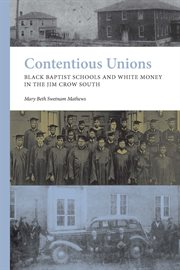
"A significant work of scholarship that tells us not just about these particular places, but more importantly about the world of Black higher education in the decades before the civil rights movement."-Paul Harvey, Distinguished Professor of History, University of Colorado, Colorado Springs In Contentious Unions: Black Baptist Schools and White Baptist Money in the Jim Crow South, Mary Beth Swetnam Mathews interweaves the stories of the founding and development of Richmond Theological Seminary (Virginia), Central City College (Macon, Georgia), and American Baptist Theological Seminary (Nashville, Tennessee)-colleges that saw challenges, complexities, and hard-won accomplishments in the Post-Reconstruction era. Her study begins just after the Civil War, when one of these institutions provided educational opportunities for newly freed slaves, and follows the fortunes of the schools through the 1960s. Mathews reveals the financial, curricular, and identity struggles of schools that came into being and survived under difficult circumstances. The institutions relied on funding from White Baptists, but also had to fight against control and exploitation from those who helped them financially. Though each school evolved with a different identity and educational mission, Mathews concludes that "they could be simultaneously symbols of racial independence as well as victims of white supremacy." As "oppositional spaces," these schools gave their communities access to the ground floor of the civil rights movement, and the author highlights their connections to some of the more famous activists such as John R. Lewis, Jo Ann Gibson Robinson, and Gordon P. Hancock. Ultimately, Mathews's book is a fascinating and complex account that uses the history of these three institutions to illuminate the origins of the long struggle for civil rights
Mode of access: World Wide Web