



Nonfiction
eBook
Details
PUBLISHED
Made available through hoopla
DESCRIPTION
1 online resource
ISBN/ISSN
LANGUAGE
NOTES
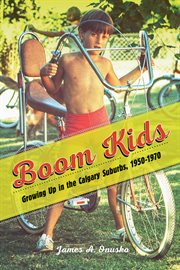
The baby boomers and postwar suburbia remain a touchstone. For many, there is a belief that it has never been as good for youngsters and their families, as it was in the postwar years. Boom Kids explores the triumphs and challenges of childhood and adolescence in Calgary's postwar suburbs. A snapshot of kids growing up in postwar suburbia. "In focusing on age as a category of analysis, the author has unearthed some very interesting material regarding, for example, the impact of the Second World War on the psyche of young baby boomers, the anxieties created by the Cold War, play and suburban space, and nighttime activities. There are still few histories of childhood in Canada, and with Boom Kids, Onusko makes a significant contribution to the field, especially through the author's use of oral history." - Catherine Gidney, author of Captive Audience: How Corporations Invaded Our Schools (2019) "This work, grounded in rich evidence, makes a significant and unique contribution to the field of childhood studies and the history of the relations and concepts of children. I particularly enjoyed Onusko's final chapter 'Things That Go Bump in the Night,' which offers fresh content and analysis on the intriguing relationship between childhood and the night but also rings true to me as a child growing up in the late 1960s and early 1970s." - Christopher Greig, author of Ontario Boys: Masculinity and the Idea of Boyhood in Postwar Ontario, 1945-1960 (WLU Press, 2014) Even as the boomer generation is beginning to 'age out', their impact on Canadian culture and politics is still influencing events today. An impressively informative and meticulously presented cultural history, "Boom Kids: Growing Up in the Calgary Suburbs, 1950-1970" is especially and unreservedly recommended for community, college, and library 20th Century Canadian Cultural History collections and supplemental curriculum studies lists. - Margaret Lane's Bookshelf, Midwest Book Review [Boom Kids] especially comes to life when we hear from the Banff Trail baby boomers themselves. Their memories and anecdotes reveal important insights into gender and class, changing sexual mores, and the challenges and limitations that came with living in a largely white suburban postwar monoculture. - M.C. Reid, Canada's History [Boom Kids] offers an innovative approach to examining the history of childhood and youth that can be extended beyond studies of the suburbs or the baby boom era. In the chapter entitled "Things that Go Bump in the Night," Onusko considers how children and teens are so often at the mercy of a clock, with curfews and bedtime representing micro and macro surveillance once darkness falls. And yet many of Onusko's participants reveal an alternative read on nighttime, how "under the cover of darkness" youth at home or going out can "escape piercing adult gazes" and perhaps even partake in a "transfer of power after nightfall," which offers opportunities for liberation and risk (150). Often as historians, we are preoccupied with long constructs of time, thinking in seasons, years, and centuries. Onusko reminds us of the importance of slowing down to think of subtle changes throughout a day and how the variable of age might impact people's experiences and perceptions of time and light. -Tarah Brookfield, Historical Studies in Education/Revue d'histoire de l'éducation 70 Considering the politicized tensions between nostalgic and critical views of postwar suburbia, Onusko's use of oral histories, and his explicit discussion of nostalgia and memory, are particularly important. Drawing on these oral histories and archival materials, he respects children's voices and sense of agency, asking how "children and adolescents influenced suburbia, just as it shaped them." Such attention to children's experiences from their own perspectives has often been
Mode of access: World Wide Web