




Nonfiction
eBook
Details
PUBLISHED
Made available through hoopla
DESCRIPTION
1 online resource
ISBN/ISSN
LANGUAGE
NOTES
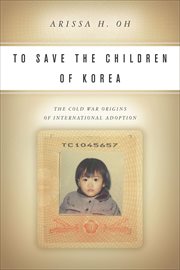
"The important . . . largely unknown story of American adoption of Korean children since the Korean War . . . with remarkably extensive research and great verve." -Charles K. Armstrong, Columbia University Arissa Oh argues that international adoption began in the aftermath of the Korean War. First established as an emergency measure through which to evacuate mixed-race "GI babies," it became a mechanism through which the Korean government exported its unwanted children: the poor, the disabled, or those lacking Korean fathers. Focusing on the legal, social, and political systems at work, To Save the Children of Korea shows how the growth of Korean adoption from the 1950s to the 1980s occurred within the context of the neocolonial US-Korea relationship, and was facilitated by crucial congruencies in American and Korean racial thought, government policies, and nationalisms. Korean adoption served as a kind of template as international adoption began, in the late 1960s, to expand to new sending and receiving countries. Ultimately, Oh demonstrates that although Korea was not the first place that Americans adopted from internationally, it was the place where organized, systematic international adoption was born. "Absolutely fascinating." -Giulia Miller, Times Higher Education " Gracefully written. . . . Oh shows us how domestic politics and desires are intertwined with geopolitical relationships and aims." -Naoko Shibusawa, Brown University "Poignant, wide-ranging analysis and research." -Kevin Y. Kim, Canadian Journal of History "Illuminates how the spheres of 'public' and 'private,' 'domestic' and 'political' are deeply imbricated and complicate American ideologies about family, nation, and race." -Kira A. Donnell, Adoption & Culture
Mode of access: World Wide Web