




Nonfiction
eBook
Details
PUBLISHED
Made available through hoopla
DESCRIPTION
1 online resource
ISBN/ISSN
LANGUAGE
NOTES
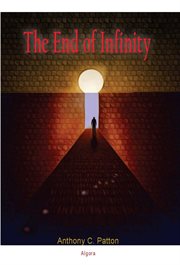
One of the most perplexing and fascinating concepts in both mathematics and philosophy is infinity. Anthony C. Patton explains why this stands as a pivotal idea, introducing the reader to perspectives that challenge conventional wisdom and encourage profound reflection on the nature of existence, reality, and intellectual thought. Infinity in Mathematics and Philosophy: Infinity has perplexed some of the greatest minds in history, from ancient philosophers to modern mathematicians. Patton begins by discussing how mathematical thinkers, such as Georg Cantor, proposed the revolutionary idea that infinity is not just a concept but a reality-and that there are multiple types and sizes of infinities. Cantor's work on set theory and cardinal numbers shook the foundation of mathematics, raising paradoxes that still intrigue scholars today. However, as Patton shows, infinity is not just a mathematical problem-it's also a philosophical conundrum. A Journey Through Paradoxes: Intriguing paradoxes arise when dealing with infinity. Concepts like Zeno's paradoxes and Hilbert's Hotel offer mind-bending scenarios that force readers to reconsider their understanding of logic, time, and space. These are explored in layman's terms, making even the most complicated ideas accessible to readers without advanced mathematical knowledge. Philosophy of Infinity - More than Numbers: While infinity often starts as a mathematical idea, it doesn't stay there. The book branches out into the philosophical implications of infinity, touching on topics such as the infinite universe, theological interpretations, and how infinity challenges our everyday understanding of time and existence. Patton expertly weaves in arguments from existentialism, metaphysics, and the philosophy of time, showing how infinity connects with profound questions about reality and the human experience. Critical Thinking and Infinity: A core theme in The End of Infinity is the development of critical thinking skills. Patton emphasizes that understanding infinity requires readers to challenge assumptions and embrace intellectual curiosity. Throughout the book, the author provides thought experiments and critical discussion prompts to encourage readers to think deeply and explore the limits of their reasoning. By the end, readers will not only have gained insight into infinity but also refined their ability to approach complex problems with a philosophical mindset. Infinity as a Gateway to Knowledge: The End of Infinity demonstrates that infinity is more than just an abstract mathematical concept; it is a profound and multifaceted idea that touches on the very fabric of reality. It serves as a gateway to understanding the complexities of the universe, the boundaries of human knowledge, and the philosophical questions that have puzzled thinkers for centuries. This book provides an accessible and thought-provoking exploration of infinity, offering readers the opportunity to engage with both mathematical and philosophical ideas in new and exciting ways. Whether you're a student, philosopher, or someone intrigued by the mysteries of existence, this book will challenge your perceptions and expand your intellectual horizons. With its engaging style, clear explanations, and depth of analysis, The End of Infinity is an eye-opener for people interested in the profound intersection of mathematics, philosophy, and critical thinking
Mode of access: World Wide Web